REFERENCE OF AUTHORS WORLDWIDE
Source:
http://authors.about.com/ & http://www.barnesandnoble.com/
Submitted
by: Ramon I. Anicete, Jr.
The Author
 Nadine
Gordimer was born on 20 November
1923 in Springs, a small mining town near Johannesburg in South Africa, of
immigrant Jewish parents. Her father, a jeweler, came from Lithuania (then in
Russia), her mother, from England. After being educated at a convent school,
Nadine Gordimer studied at the University of Witwatersrand in
Johannesburg. She has traveled extensively in Africa, Europe, and North
America, where she has often undertaken lecture tours, but has continued to
live in Johannesburg; married since 1954 to a businessman, Reinhold Cassirer.
The couple has a son and each has a daughter from a previous marriage.
Nadine
Gordimer was born on 20 November
1923 in Springs, a small mining town near Johannesburg in South Africa, of
immigrant Jewish parents. Her father, a jeweler, came from Lithuania (then in
Russia), her mother, from England. After being educated at a convent school,
Nadine Gordimer studied at the University of Witwatersrand in
Johannesburg. She has traveled extensively in Africa, Europe, and North
America, where she has often undertaken lecture tours, but has continued to
live in Johannesburg; married since 1954 to a businessman, Reinhold Cassirer.
The couple has a son and each has a daughter from a previous marriage.
Nadine Gordimer began to write at the age of nine and her first short story was
published in a South African magazine when she was only fifteen. Her first
collection of short stories, Face to Face, was published ten years later in
1949. Her first novel, The Lying Days, appeared in 1953. She has now published
10 novels and 7 collections of short stories, as well as a few volumes of
literary criticism and in addition, a large number of articles, speeches and
lectures on different subjects. Some of her books have at times been banned in
her native country.
Nadine Gordimer has always
aspired to live as a private individual outside the public eye, but
international fame and the many major awards which followed (among them the Booker Prize in 1974 for The
Conservationist), honorary doctorates abroad (she has declined one in South
Africa), various positions (she is, for example, Vice President of
International P.E.N.), and her continual involvement on behalf of literature
and free speech in a police state, where censorship and persecution of books
and people exist, have made her "the doyenne of South African
letters".
Back To Top
Short Story Collections:
|
Novels:
|
From the Swedish Academy's Press Release, 3 October
1991.
The Book
 Description from The Reader's
Catalog
Description from The Reader's
Catalog
A convincing portrait of an Afrikaner industrialist, a man at once ambitious,
cynical, sensual, and sharply observant
Author Note from The Reader's
Catalog
"Nadine Gordimer is one of the world's finest writers," wrote Joyce Carol
Oates in the New York Times Book Review, expressing a widely held opinion about
the woman who has dominated the South African literary scene for the past 30
years. The evolution of Gordimer's work reflects her growing political
involvement: while the earliest stories deal predominantly with the lives of
liberal whites and their oblique relationship with blacks, the later work looks
towards the future, anticipating a post-revolutionary period.
The Author
 Bill Bryson returned to America after two
decades in England. To rediscover his native land, Bryson impulsively set about
hiking the Appalachian Trail, a 2200-mile long path that stretches from Georgia
to Maine. His companion on this adventure was one Stephen Katz, an equally
ill-prepared and overweight gent with a penchant for beer and donuts. Together
they scaled mountains, forded streams, and braved the elements. The result is A
Walk in the Woods, an absolutely hilarious book that the story of what happens to
two hapless middle-aged guys who go for a walk in the wilderness and find
themselves hopelessly out of their depths. Be prepared to laugh out loud. It is
also an acute observation of the splendor of our increasingly threatened
Appalachian woods. This year marks the trail's 75th anniversary, and Bryson's
book is a paean to its place in America's history and cultural landscape.
Bill Bryson returned to America after two
decades in England. To rediscover his native land, Bryson impulsively set about
hiking the Appalachian Trail, a 2200-mile long path that stretches from Georgia
to Maine. His companion on this adventure was one Stephen Katz, an equally
ill-prepared and overweight gent with a penchant for beer and donuts. Together
they scaled mountains, forded streams, and braved the elements. The result is A
Walk in the Woods, an absolutely hilarious book that the story of what happens to
two hapless middle-aged guys who go for a walk in the wilderness and find
themselves hopelessly out of their depths. Be prepared to laugh out loud. It is
also an acute observation of the splendor of our increasingly threatened
Appalachian woods. This year marks the trail's 75th anniversary, and Bryson's
book is a paean to its place in America's history and cultural landscape.
In this issue of Bold Type, you'll find an interview with Bill Bryson, an audio
reading by the author, and an excerpt from A Walk in the Woods.
Photo of Bill Bryson copyright © Jerry Bauer
Back To Top
The Book
 Annotation
A laugh-out-loud account of an outrageously
rugged hike -- by the beloved comic author of Lost Continent and Notes from a
Small Island. Published on the 75th anniversary year of the Appalachian Trail.
From The Publisher
For reasons even he didn't understand, Bill Bryson decided in 1996 to walk the
2,100-mile Appalachian trail. Winding from Georgia to Maine, this uninterrupted
'hiker's highway' sweeps through the heart of some of America's most beautiful
and treacherous terrain. Accompanied by his infamous crony, Stephen Katz,
Bryson risks snake bite and hantavirus to trudge up unforgiving mountains, plod
through swollen rivers, and yearn for cream sodas and hot showers. This
amusingly ill-conceived adventure brings Bryson to the height of his comic
powers, but his acute eye also observes an astonishing landscape of silent
forests, sparkling lakes, and other national treasures that are often ignored
or endangered. Fresh, illuminating, and uproariously funny, A Walk in the Woods
showcases Bill Bryson at his very best.
Don't look to A Walk in the Woods for forced
revelations about failed relationships or financial ruin or artistic
insecurity. Bryson is hiking the trail because it's there, and he's great
company right from the start -- a lumbering, droll, neatnik intellectual who
comes off as equal parts Garrison Keillor, Michael Kinsley and (given his
fondness for gross-out humor) Dave Barry. —Dwight Garner
The Author
 The youngest of three children, Carol Shields
was born in Oak Park, Illinois in 1935. She studied at
Hanover College, the University of Exeter in England, and the University of
Ottawa, where she received an M.A. In 1957 she married Donald Hugh Shields, a
professor of Civil Engineering, and moved to Canada. She has lived there ever
since. In addition to raising five children, all of whom are now grown, Shields
has worked as an editorial assistant for the journal Canadian Slavonic Papers
and as a professor at the University of Ottawa, the University of British
Columbia, and the University of Manitoba, where she has taught for the last
fifteen years. She lives in Winnipeg.
The youngest of three children, Carol Shields
was born in Oak Park, Illinois in 1935. She studied at
Hanover College, the University of Exeter in England, and the University of
Ottawa, where she received an M.A. In 1957 she married Donald Hugh Shields, a
professor of Civil Engineering, and moved to Canada. She has lived there ever
since. In addition to raising five children, all of whom are now grown, Shields
has worked as an editorial assistant for the journal Canadian Slavonic Papers
and as a professor at the University of Ottawa, the University of British
Columbia, and the University of Manitoba, where she has taught for the last
fifteen years. She lives in Winnipeg.
Shields is the
author of several novels and short-story collections, including The Orange
Fish, Swann, Various Miracles, Happenstance, and The Republic of Love. Her
books have won a Canada Council Major Award, two National Magazine Awards, the
Canadian Author's Award, and a CBC short story award. The Stone Diaries was
nominated for the National Book Critics Circle Award and the 1993 Booker Prize,
and won Canada's Governor General Award. It was also named one of the best
books of the year by Publishers Weekly and a "Notable Book" by The
New York Times Book Review. Excerpted from the Penguin Biography on Carol
Shields.
Back To Top
The Book
 Synopsis
This is a collection of short stories by the author of Swann (BRD 1989), and
The Republic of Love (BRD 1992).
Reviews
From D.O. Spettigue - Canadian Literature
Twelve stories in the post-post fashion. They begin casually, they wander
about, and sometimes they have little story line, perhaps no closure. They have
theme, though; they have, usually, a consistent point of view. Carol Shields is
a critic, is a novelist, is an excellent writer of short stories; she knows how
these things work. She must remind her readers of Alice Munro. Not that you
would confuse Shields and Munro, though the worlds they draw many of their
subjects from are often the same: the professional maze, with its own rules for
survival; the domestic scene, banal but viewed in an odd light; the perpetual,
depressing puzzle of the generations . .Like Munro, Shields gets it brightly,
deceptively, disturbingly right
The Author
Frantz Fanon's relatively short life yielded
two potent and influential statements of anti-colonial revolutionary thought,
Black Skin, White Masks (1952) and The Wretched of the Earth (1961), works
which have made Fanon a prominent contributor to postcolonial studies.
Fanon was born in 1925, to a middle-class family in the French colony of
Martinique. He left Martinique in 1943, when he volunteered to fight with the
Free French in World War II, and he remained in France after the war to study
medicine and psychiatry on scholarship in Lyon. Here he began writing political
essays and plays, and he married a Frenchwoman, Jose Duble. Before he left
France, Fanon had already published his first analysis of the effects of racism
and colonization, Black Skin, White Masks (BSWM), originally titled "An
Essay for the Disalienation of Blacks," in part based on his lectures and
experiences in Lyon.
Back To Top
The
Book
 BSWM is part manifesto, part analysis; it both
presents Fanon's personal experience as a black intellectual in a whitened
world and elaborates the ways in which the colonizer/colonized relationship is
normalized as psychology. Because of his schooling and cultural background, the
young Fanon conceived of himself as French, and the disorientation he felt
after his initial encounter with French racism decisively shaped his
psychological theories about culture. Fanon inflects his medical and
psychological practice with the understanding that racism generates harmful
psychological constructs that both blind the black man to his subjection to a
universalized white norm and alienate his consciousness. A racist culture
prohibits psychological health in the black man.
BSWM is part manifesto, part analysis; it both
presents Fanon's personal experience as a black intellectual in a whitened
world and elaborates the ways in which the colonizer/colonized relationship is
normalized as psychology. Because of his schooling and cultural background, the
young Fanon conceived of himself as French, and the disorientation he felt
after his initial encounter with French racism decisively shaped his
psychological theories about culture. Fanon inflects his medical and
psychological practice with the understanding that racism generates harmful
psychological constructs that both blind the black man to his subjection to a
universalized white norm and alienate his consciousness. A racist culture
prohibits psychological health in the black man.
For Fanon, being colonized by a language has larger
implications for one's consciousness: "To speak . . . means above all to
assume a culture, to support the weight of a civilization" (17-18).
Speaking French means that one accepts, or is coerced into accepting, the
collective consciousness of the French, which identifies blackness with evil
and sin. In an attempt to escape the association of blackness with evil, the
black man dons a white mask, or thinks of himself as a universal subject
equally participating in a society that advocates equality supposedly
abstracted from personal appearance. Cultural values are internalized, or
"epidermal zed" into consciousness, creating a fundamental
disjuncture between the black man's consciousness and his body. Under these
conditions, the black man is necessarily alienated from himself.
Fanon insists, however, that the category "white" depends for its
stability on its negation, "black." Neither exists without the other,
and both come into being at the moment of imperial conquest. Thus, Fanon
locates the historical point at which certain psychological formations became
possible, and he provides an important analysis of how historically-bound
cultural systems, such as the Orientalist discourse Edward Said describes, can
perpetuate themselves as psychology. While Fanon charts the psychological
oppression of black men, his book should not be taken as an accurate portrait
of the oppression of black women under similar conditions. The work of
feminists in postcolonial studies undercuts Fanon's simplistic and unsympathetic
portrait of the black woman's complicity in colonization.
The Author
Günter Grass Wins Nobel Prize for Literature
"Whose frolicsome black fables portray the forgotten face of history"
One of the more inventive authors of the 20th Century, Polish/German author
Günter Grass was awarded the 1999 Nobel Prize for Literature. His 1959 novel
The Tin Drum is widely regarded his masterpiece, a novel depicting the horrors
of World War II via the story of an evil genius trapped in the body of a
three-year-old boy who overpowers others via a toy drum. Grass is an author of
metaphors both subtle and extreme, and in tune with the German tradition of
intellectual verisimilitude--his works demonstrate an encyclopedic
understanding of intellectual and political history.
Back To Top
The
Book
 The Nobel Prize announcement reports that "Günter
Grass has described himself as a "Spätaufklärer", a belated apostle
of enlightenment in an era that has grown tired of reason." The world
Grass describes is one in which absurdity has become a condition of being.
Reason itself has become a platonic ideal, outside the practice of everyday
life. Perhaps this is the reason why Grass himself so often writes in the
allegorical mode--the real world itself is so full of incomprehensible terror
that human interactions make more sense when distilled into the form of
extended metaphor and fable.
The Nobel Prize announcement reports that "Günter
Grass has described himself as a "Spätaufklärer", a belated apostle
of enlightenment in an era that has grown tired of reason." The world
Grass describes is one in which absurdity has become a condition of being.
Reason itself has become a platonic ideal, outside the practice of everyday
life. Perhaps this is the reason why Grass himself so often writes in the
allegorical mode--the real world itself is so full of incomprehensible terror
that human interactions make more sense when distilled into the form of
extended metaphor and fable.
Grass is known as one of the great authors of the century not only for tackling
very dark and difficult subjects, but also for his technical experimentation
and range. The styles of the Danzig Trilogy novels--The Tin Drum, Cat and
Mouse, and Dog Years, are all discernibly different in style and approach, ranging
from an austere minimalist prose style to everything-and-the-kitchen-sink
maximalism. His sudden departures from gritty realism to carnivalesque fable
place him in the same camp as great magical realists such as Gabriel Garcia
Marquez and Salman Rushdie.
The Nobel Prize announcement comes hot on the heels of another incident which
placed Günter Grass in the media spotlight recently here in the U.S., as the
victim of one of the most flagrant examples of wholesale censorship in recent
memory. In 1997, on June 25th, Oklahoma County Judge Richard Freeman ruled that
parts of the 1979 Cannes Film Festival and Academy Award-winning film version
of The Tin Drum were "obscene." In the weeks that followed, Oklahoma
City Police stormed libraries, video stores, and private homes to seize copies
of the film, beginning a court battle that dragged out until December of 1998,
when the ruling was overturned on appeal. The Tin Drum Controversy was a battle
that pitted the forces of free expression and those of legislative morality.
Oklahoma County Librarian Lee Brawner was the principle advocate of keeping The
Tin Drum on the library shelves. A 1998 Hugh M. Hefner First Amendment Award in
the Education category was presented to Lee Brawner by the ALA at a ceremony in
New York City. The citation praised "Lee Brawner: Executive director of
the Metropolitan Library System serving Oklahoma County who, despite
unrelenting attacks by religious conservatives, with energy, clarity and
devotion to the principles of intellectual freedom, educated the citizens of
Oklahoma City about the dangers of censoring library materials."
The Author
This novel, the American debut of a popular contemporary
Japanese writer, will have a familiar ring to Western ears. The narrative moves
adroitly through mystery, fable, pensive realism, and modernist absurdity to
tell the tale--at least on the surface--of a Japanese man caught up in a
puzzling quest for a somewhat mystical sheep. The spare style echoes Raymond
Carver, Dashiell Hammett, and Raymond Chandler, with matter-of-fact absurdities
reminiscent of John Irving and, in less inspired moments, Tom Robbins. While
the climax of the story is somewhat unrewarding, many readers will enjoy being
pulled along by the playful and engaging style and fluid structure. Interesting
as an example of current Japanese writing and as an unusually hip and
irreverent look at contemporary Japanese society, this would be a nice addition
to larger fiction collections.-- Mark Woodhouse, Elmira Coll., N.Y.
Back To Top
The Book
 Synopsis
"Adventure waylays Mr. Murakami's narrator, sending him first a young
woman with beautiful, paranormally endowed ears and then the sinister,
black-suited lieutenant of a dying right-wing boss, who threatens him into
accepting a case. What is this case? To find a sheep with a chestnut-colored
star on its back, a sheep that holds the key to the survival of the boss and
his empire. Forty-odd years before, this anomalous sheep had mysteriously
implanted itself in the boss's brain and taken over his will." (NY Times
Book Rev) Originally published in Japan in 1982 under the title Hitsuji o
meguru boken.
Annotation
Modern Japanese fiction will not be seen in the same light again. The American
debut of Japan's premier contemporary writer introduces a fresh, irreverent
tale with a 30-year-old modern-day hero.
Description from The Reader's
Catalog
Murakami, born in 1949, speaks for a new generation of Japanese, and his
whimsical and ingenious novels have made him a best selling author in Japan. A
Wild Sheep Chase, his first work translated into English, has been received
enthusiastically for its unique blend of comedy, fantasy, and mystery
The Author
Mario
Vargas Llosa was born in Arequipa, Perú, on March 28, 1936. He attended the
University of San Marcos in Lima and the University of Madrid, where he
obtained the doctorate in 1959. Writer, journalist, critic and teacher, he has
taught at the Queen Mary College and Kings College of the University of London,
Washington State University, Pullman, the University of Puerto Rico, Río
Piedras, and Columbia University in New York. He was a Fellow at the Woodrow
Wilson Center, Washington, D.C. He has been the recipient of many literary
prizes among which are the Barral Prix Biblioteca Breve (1962), the Premio de
la Crítica Española (1963 and 1967), the Premio Nacional de la Novela (1967),
the Premio del Instituto Italo Latinoamericano (Italy, 1982), the Ritz Paris
Hemingway Award (1985), and the Premio Internacional de Literature Rómulo
Gallegos. Vargas Llosa was a journalist with La Industria, Piura, Perú, with
Radio Panamericana and La Crónica, both of Lima and with Agence France-Presse
and the French Radio-Television Network in Paris. He was also the host of the
Peruvian television program "The Tower of Babel". In 1990, Vargas
Llosa was the unsuccessful candidate for the Presidency of Perú for the Liberty
Movement Party.
Mayor Published Works: Los jefes (Lima:
Editorial Roca, 1959); La ciudad y los perros (Barcelona: Seix Barral, 1963),
English translation by Lisander Kemp titled The Time of the Hero (New York:
Grove, 1966); La casa verde (Barcelona: Seix Barral, 1969), English translation
by Gregory Rabassa published as The Green House (New York: Harper & Row, 1968);
Conversación en la catedral (Barcelona: Seix Barral, 1969), English translation
by Gregory Rabassa published as Conversation in the Cathedral (New York: Harper
& Row, 1975); García Márquez: historia de un deicídio (Barcelona: Seix
Barral, 1971); Pantaleón y las visitadoras (Barcelona: Seix Barral, 1973),
English translation by Ronald Christ and Gregory Kolovakos published as Captain
Pantoja and the Special Services (New York: Harper & Row, 1978); La orgía
perpetua: Flaubert y "Madame Bovary" (Barcelona: Seix Barral, 1975),
English translation by Helen Lane published as The Perpetual Orgy: Flaubert and
Madame Bovary (New York: Farrar, Straus, 1986); La guerra del fin del mundo
(1981), English translation by Helen Lane published as The War of the End of the
World (New York: Farrar, Straus, 1984); Historia de Mayta (Barcelona: Seix
Barral, 1985), English translation by Alfred MacAdam titled The Real Life of
Alejandro Mayta (New York: Farrar, Straus, 1986); ¿Quién mató a Palomino
Molero? (Barcelona: Seix Barral, 1986), English translation by Alfred MacAdam
published as Who Killed Palomino Molero? (New York: Farrar, Straus, 1987); El
hablador (Barcelona: Seix Barral, 1989), English translation by Helen Lane
published as The Storyteller (New York: Farrar, Straus, 1989).
Back To Top
The Book
 This book "recounts the
rebellion (1896-97) in Brazil's poverty-stricken northeast of Antonio
Conselheiro and his disciples against the country's newly formed republic. . .
. The novel describes the four expeditions launched by the Brazilian government
and the final annihilation of Canudos by a modern army of some 6,000 men."
(Choice)
This book "recounts the
rebellion (1896-97) in Brazil's poverty-stricken northeast of Antonio
Conselheiro and his disciples against the country's newly formed republic. . .
. The novel describes the four expeditions launched by the Brazilian government
and the final annihilation of Canudos by a modern army of some 6,000 men."
(Choice)
From Salman Rushdie - The New Republic
The greatest qualities of this excellent novel are, I believe, neither its
inexorable Greek progress toward the slaughter of the innocents with which it
climaxes, nor its intellectual rigor. They are, rather, its refusal ever
toabandon the human dimension in a story that could so easily have become
grandiose; also a sense of ambiguity, which enables Vargas Llosa to keep his
characters three-dimensional, and not merely the representatives of Good, or
Evil, or some such abstraction; and finally, a profound awareness of the tragic
ironythat makes tens of thousands of ordinary women and men die fighting
against the Republic that was created, in theory, precisely to serve them, and
to protect them against the rapacity of their former feudal overlords
The Author
 Solzhenitsyn: Life and Times
The favorite subject of exiled Soviet
novelist and historian Alexander Solzhenitsyn is his homeland. Solzhenitsyn has
chronicled the story of a world unto itself, the Soviet prison system.
Alexander
Isayevich Solzhenitsyn was born on Dec. 11, 1918, in Kislovodsk, Russia. After
graduating with a degree in mathematics from the University of Rostov-on-Don,
Solzhenitsyn served in the Red Army artillery in World War II. In 1945 he was
arrested for criticizing Joseph Stalin in a letter and was imprisoned for eight
years. While imprisoned, Solzhenitsyn worked in a labor camp and a prison
research institute and first began to write poetry. In prison he was also
diagnosed as having cancer. After his release on the day of Stalin's death,
Solzhenitsyn was forced to spend three years in exile.
Back To Top
The Book
 His
first book, `One Day in the Life of Ivan Denisovitch', published in Russian in
1962, tells the story of a day in the life of an inmate in a Soviet labor camp.
The book brought Solzhenitsyn instant recognition. `The First Circle' and
`Cancer Ward', both published abroad in 1968, made Solzhenitsyn internationally
famous. His criticism of government repression led to a ban on publication of
his work in the Soviet Union after the mid-1960s. His books continued to be
published abroad, however, and were circulated underground inside the Soviet
Union. Solzhenitsyn was awarded the Nobel prize for literature in 1970 but was
afraid to leave the Soviet Union to receive it for fear that the government
would not allow him to reenter the country when he returned.
His
first book, `One Day in the Life of Ivan Denisovitch', published in Russian in
1962, tells the story of a day in the life of an inmate in a Soviet labor camp.
The book brought Solzhenitsyn instant recognition. `The First Circle' and
`Cancer Ward', both published abroad in 1968, made Solzhenitsyn internationally
famous. His criticism of government repression led to a ban on publication of
his work in the Soviet Union after the mid-1960s. His books continued to be
published abroad, however, and were circulated underground inside the Soviet
Union. Solzhenitsyn was awarded the Nobel prize for literature in 1970 but was
afraid to leave the Soviet Union to receive it for fear that the government
would not allow him to reenter the country when he returned.
Back To Top
 In
1974, shortly after the first parts of `The Gulag Archipelago' were published
in Paris, Solzhenitsyn was arrested and tried for treason. Exiled from the
Soviet Union, he settled in Switzerland and finally took possession of his
Nobel prize. He later settled in the United States. In 1980 he published `The
Mortal Danger' in English. Because of changes in official Soviet policy, most
of his works once again became available to Soviet readers in 1989. In
September 1991 Soviet officials dropped the treason charges lodged against
Solzhenitsyn in 1974. -- from Comptons Encyclopedia
In
1974, shortly after the first parts of `The Gulag Archipelago' were published
in Paris, Solzhenitsyn was arrested and tried for treason. Exiled from the
Soviet Union, he settled in Switzerland and finally took possession of his
Nobel prize. He later settled in the United States. In 1980 he published `The
Mortal Danger' in English. Because of changes in official Soviet policy, most
of his works once again became available to Soviet readers in 1989. In
September 1991 Soviet officials dropped the treason charges lodged against
Solzhenitsyn in 1974. -- from Comptons Encyclopedia
The Author
 Peter Carey is the multi-award-winning author
of five novels, Bliss, Ilywhacker, Oscar and Lucinda, The Tax Inspector and The
Unusual Life of Tristan Smith. He has won every major literary award in
Australia, and in 1998 he won the Booker Prize for his novel Oscar and Lucinda.
Peter Carey is the multi-award-winning author
of five novels, Bliss, Ilywhacker, Oscar and Lucinda, The Tax Inspector and The
Unusual Life of Tristan Smith. He has won every major literary award in
Australia, and in 1998 he won the Booker Prize for his novel Oscar and Lucinda.
Jack Maggs, his latest
novel, has just been awarded the 1998 Miles Franklin Award for best Australian fiction.
The story follows Jack Maggs, who bears a striking similarity to Magwitch of
Great Expectations.
University of Queensland Press has recently
re-released The Fat Man
In History, a collection of short stories originally published in
1974. His highly acclaimed short stories are now gathered together in Collected
Stories. He has also written a book for children, The Big Bazoohley.
Born in Bacchus Marsh, Victoria in 1943,
Peter Carey now lives in New York with his wife and two sons.
Back To Top
Praise for Peter Carey's books
|
The Fat
Man In History |
Collected Stories |
Bliss |
Illywhacker |
|
Oscar and Lucinda -
Winner of the Booker Prize |
The Tax Inspector |
The
Unusual Life of Tristan Smith |
|
The Book
 Synopsis
This story is set in England and Australia during the 1860s.
"Oscar'snarrow-minded father is determined to bring his son up as a loyal
member of his strict fundamentalist sect. . . . {Lucinda's} mother, a
frustrated believerin women's rights, expected the evolving continent of
Australia to be the place to realize her dream--to see industrialization become
'the great hope for women.' . . . Oscar is determined that God has called him
to be an Anglican missionary. Lucinda is set on owning a glass factory. . . .
{Oscar and Lucinda meet, and decide} to build a glass church . . . and give it
to an isolated churchless community . . .. {Oscar} risks all he owns on a bet
that he will see the church reach its destination. So he becomes part of a
wretched little expedition into the savage outback." (Christ Sci Monit)
Winner
of the Booker Prize, a critically acclaimed, large-scale, brilliantly styled,
continuously engrossing love story set in mid-19th-century England and
Australia.
From Beryl Bainbridge - The New York Times
Book Review
The
building of this church, which is not completed until the book is nearly
through, commences early. The reflection of its glass bulk dazzles the reader
from the opening chapters. Lucinda's church is a great white whale of an
adversary, a Moby Dick improbably spawned in the rock pools of Devon. . . . To
my mind, Oscar's childhood is the best part of the book; the child dominates
the pages. The rest of the novel, in which Oscar leaves his father, defects to
the conventional Anglican household of the Rev. Hugh Stratton, is prepared for
Oxford, becomes a betting man, takes holy orders and sails to his destiny in
New South Wales, is racy with characters, teeming with invention and expressed
in superlative language. And yet somehow, after he is grown up, Oscar is
diminished.
Back To Top
The Author
Professor Isabelo T. Crisostomo is a
prominent Filipino author, biographer, and historian. His biographies include those
of former Philippine Presidents Ferdinand Marcos (Marcos the Revolutionary) and
Corazon C. Aquino (Aquino, Profile of a President) and of former First Lady
Imelda R. Marcos (Heart of the Revolution). Additionally, his Modern
Advertising for Filipinos and Advertising: Background, Theory, and Practice are
well-respected university textbooks.
Crisostomo, who visits the U.S.
occasionally, lives with this wife in Quezon City, Metro Manila, Philippines.
Back To Top
The
Book
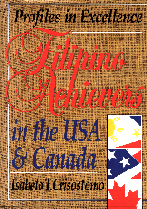
Filipino Achievers in the USA and Canada: Profiles in Excellence brings to life the Filipino odyssey in North America and examines the lives and times of notable men and women who won against tremendous odds in their own fields of endeavor.
Meet the more than 100 outstanding Filipinos whose significant achievements epitomize the spirit of the American and Canadian democratic ideals.
The achievers profiled in this book are wonderful role models. They have transcended their ethnicity, surmounted various obstacles, and met their destiny. Their lives and accomplishments are a window by which others can view these individuals and the Filipino community. By getting to know and respect their values, cultures, traditions, and characteristics, others can appreciate their strengths and acknowledge their contributions to America's "melting pot" society